High energy physics
A Calabi–Yau toolkit
We introduce CIPro, a new toolkit that automates calculations on Calabi–Yau geometries and helps explore string compactifications and vacua.
YH LAACJGSLAL
ArXivLAACJGSLALThe London Institute’s papers are the official record of our discoveries. They allow others to build on and apply our work. Each one is the result of many months of research, so we strive to make them clear, inspiring and beautiful, and publish them in leading journals.
We introduce CIPro, a new toolkit that automates calculations on Calabi–Yau geometries and helps explore string compactifications and vacua.
LAACJGSLAL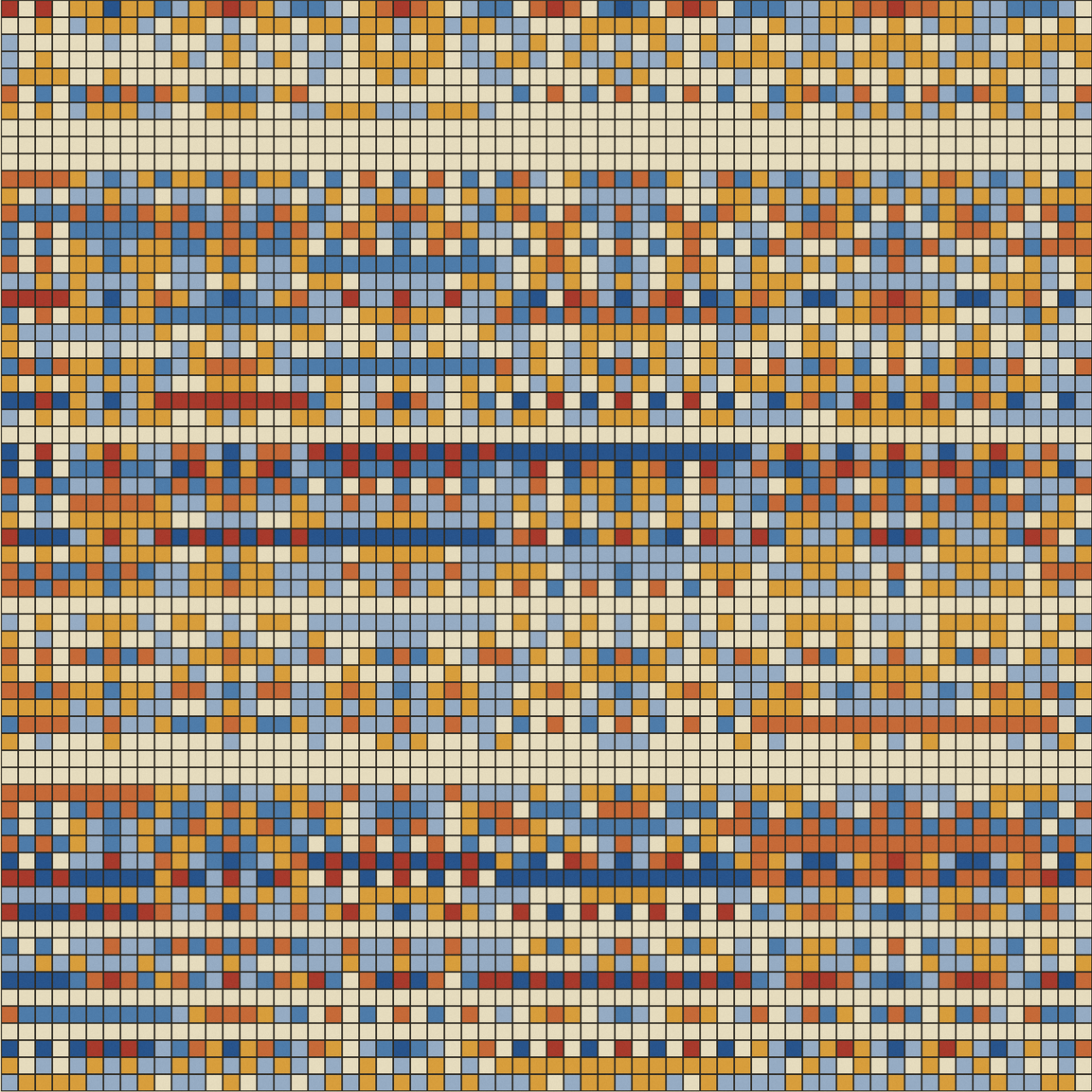
Computer vision distinguishes elliptic curves from random data and predicts analytic rank by reading arithmetic patterns in digital images.
KLTOYQ
Birational methods in algebraic geometry are used to explicitly describe the vacuum structure of the Minimal Supersymmetric Standard Model.
VJBNHSMS
This obituary celebrates the life and work of John Keith Stuart McKay, highlighting the mathematical miracles for which he will be remembered.
Weight pruning uncovers critical behaviour in deep neural networks with a sharp transition from functional cooperation to disordered failure.
Machine learning finds “champion” codes by predicting and optimising their minimum Hamming distance, a measure of a code’s robustness.
The rich and intricate vacuum geometry of the Minimal Supersymmetric Standard Model—a complex manifold—is characterised for the first time.
Neural networks classify simple finite groups by generators, unlike earlier methods using Cayley tables, leading to a proven explicit criterion.
We compute Futaki invariants for gauge theories from D3-branes that probe toric Calabi-Yau singularities arising from reflexive polytopes.
We show reinforcement learning can be used to check whether a certain class of quantum field theory has a finite spectrum of stable particles.
Using Newton polynomials from reflexive polygons, we find that the Mahler measure and dessin d’enfants are in one-to-one correspondence.
3-manifolds represented as isomorphism signatures of their triangulations and associated Pachner graphs are analysed with machine learning.
We use simulated annealing to efficiently construct all brane tilings that encode supersymmetric gauge theories and discover a new one.
Using Inception, a convolutional neural network, we predict certain divisibility invariants of Calabi-Yau manifolds with up to 90% accuracy.
Machine learning generates desirable triangulations of geometric objects that are required for Calabi-Yau compactification in string theory.
Reviewing progress in the field of AI-assisted discovery for maths and theoretical physics reveals a triumvirate of different approaches.
Certain properties of the bivariate cubic equations used to prove Fermat’s last theorem exhibit flocking patterns, machine learning reveals.
Genetic symbolic regression methods reveal the relationship between amoebae from tropical geometry and the Mahler measure from number theory.
An AI algorithm of few-shot learning finds that the vast string landscape could be reduced by only seeing a tiny fraction to predict the rest.
Coxeter transformations for root diagrams of simply-laced Lie groups are exhaustively computed then machine learned to very high accuracy.
Topological quantities for the Calabi-Yau link construction of G2 manifolds are computed and machine learnt with high performance scores.
Genetic algorithms, which solve optimisation problems in a natural selection-inspired way, reveal previously unconstructed Calabi-Yau manifolds.
By approximating the basis of eigenfunctions, we computationally determine the harmonic modes of bundle-valued Laplacians on Calabi-Yau manifolds.
Investigating cluster algebras through the lens of modern data science reveals an elegant symmetry in the quiver exchange graph embedding.
AI can predict invariants of low genus arithmetic curves, including those key to the Birch-Swinnerton-Dyer conjecture—a millennium prize problem.
Machine-learning 2-dimensional amoeba in algebraic geometry and string theory is able to recover the complicated conditions from so-called lopsidedness.
Cluster variables in Grassmannian cluster algebras can be classified with HPC by applying the tableaux method up to a fixed number of columns.
The eigenvalues of the mortality equation fall into two classes—the flower and the stem—but only the stem eigenvalues control the dynamics.
A neural network learns to classify different types of spacetime in general relativity according to their algebraic Petrov classification.
Editorial of the last set of lectures given by the founder, McKay, of Moonshine Conjectures, the proof of which got Borcherds the Fields Medal.
Certain states in quantum field theories are described by the geometry and algebra of melting crystals via properties of partition functions.
Mahler measure from number theory is used for the first time in physics, yielding “Mahler flow” which extrapolates different phases in QFT.
Neural networks find efficient ways to compute the Hilbert series, an important counting function in algebraic geometry and gauge theory.
Unsupervised machine-learning of the Hodge numbers of Calabi-Yau hypersurfaces detects new patterns with an unexpected linear dependence.
Neural networks find numerical solutions to Hermitian Yang-Mills equations, a difficult system of PDEs crucial to mathematics and physics.
Machine-learning methods can distinguish between Sato-Tate groups, promoting a data-driven approach for problems involving Euler factors.
We find a physical interpretation, in terms of combinatorial topological string theory, of a classic result in finite group theory theory.
Groethendieck's “children’s drawings”, a type of bipartite graph, link number theory, geometry, and the physics of conformal field theory.
Machine-learning is a powerful tool for sifting through the landscape of possible Universes that could derive from Calabi-Yau manifolds.